

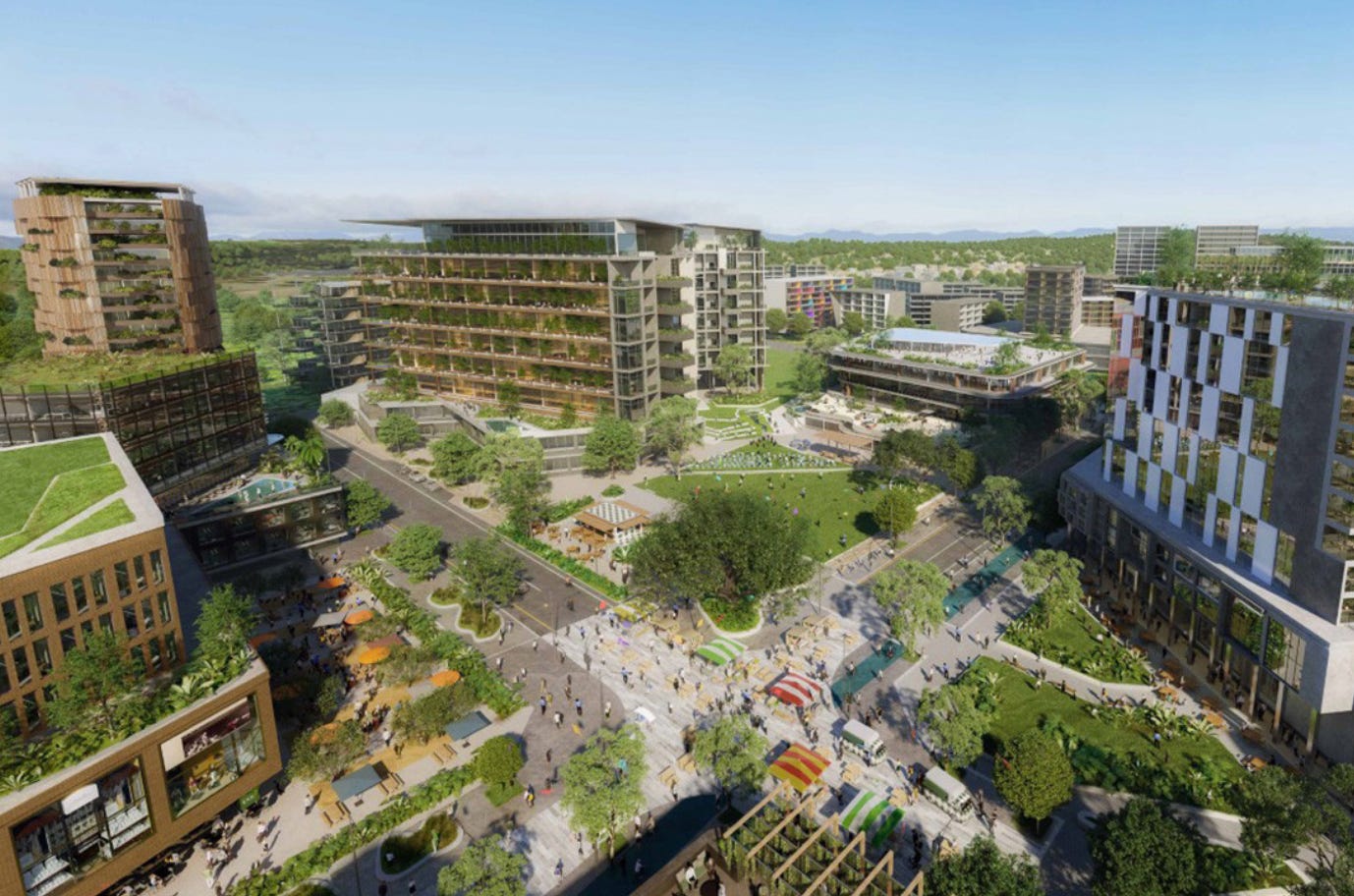
If Part One made the case for why cities are the true engines of healthy longevity, Part Two turns to a more concrete question:
How do we build a Longevity City?
The answer is not a mystery. Across the world, the components of a longevity-focused civic architecture already exist — scattered across different cities, policy domains, digital infrastructures, and public health systems. The challenge is to assemble them into a coherent framework.
I call this framework The Longevity City Stack: a layered model for designing cities that systematically extend healthspan, compress the red zone, reduce inequality, and accelerate verifiable progress in preventive and regenerative medicine.
The Stack has five layers:
Sewer Socialism 2.0 — the built-environment and social-infrastructure foundation
Urban Longevity Labs — civic R&D for early detection and regenerative medicine
The Open Smart City — federated, privacy-centric health data infrastructure
Municipal Accelerationism (m/acc) — public innovation hubs and moonshots grounded in universal flourishing
The Longevity Cities Network — intercity protocols, shared standards, and global scaling
Together, these layers form a democratic, technoprogressive pathway for transforming longevity science into a public good.
Let’s take each in turn.
1. Sewer Socialism 2.0: Rebuilding the Infrastructures of Long Life
In the early 20th century, municipal socialists transformed cities by focusing on the systems people use every day: clean water, sanitation, transit, public health departments, libraries, and safe streets.
Their core insight remains essential and we must continue to finish the work of the first progressive movement, which understood a basic axiom:
Human flourishing begins with the built environment.
But today, our understanding of the determinants of longevity is far broader. Health is shaped by:
mobility patterns
housing stability
air quality
access to shade and green space
workload and wages
social participation
heat vulnerability
neighborhood design
universal accessibility
These are the physical and social determinants of lifespan and healthspan.
A longevity-focused city must therefore adopt what we might call Sewer Socialism 2.0 — a 21st-century upgrade to the everyday systems that govern how people live, move, breathe, and connect.
This includes:
safe, multimodal transportation networks
abundant and accessible housing
universal-design streets and buildings
parks, cooling corridors, and green infrastructure
child-, parent-, and elder-friendly neighborhoods
public institutions centered on social participation and care
This is Layer 1 of the Longevity City Stack.
Every other layer depends on it.
2. Urban Longevity Labs: Civic R&D for Healthspan Extension
Once physical and social infrastructures support baseline health, cities can create the civic capacity to adopt next-generation interventions.
Enter Urban Longevity Labs — publicly governed R&D ecosystems that coordinate early detection, biomarker validation, regenerative medicine pilots, and community-based clinical trials.
These labs allow cities to:
run universal early-screening programs
offer genome sequencing at scale
map biological age and other biomarkers
test and validate new diagnostic tools
pilot regenerative medicine interventions
integrate wearables, sensors, and digital health systems into a coordinated care network
Crucially, Urban Longevity Labs operate under democratic public oversight. They are designed to:
prevent corporate data monopolies
eliminate vendor lock-in
guard against pseudoscience and hype cycles
ground innovation in verifiable, open evidence
build public trust
Urban Longevity Labs form Layer 2 of the Stack — the civic science infrastructure through which longevity innovation becomes trustworthy, equitable, and transparent.
3. The Open Smart City: A Public-Interest Health Data Infrastructure
Every longevity intervention, from early detection to regenerative medicine, depends on high-quality, interoperable, privacy-secure data.
The problem is that today’s “smart city” models tend to reproduce corporate capture: closed algorithms, proprietary data pipelines, and opaque surveillance practices.
The Longevity City requires the opposite.
It needs The Open Smart City: a federated, free/libre/open-source (FLOSS) civic data infrastructure built around:
open standards
transparent algorithms
strong encryption
individual data sovereignty
municipal data trusts
interoperable APIs
city-to-city data portability
In this model, health data becomes a civic asset, not a commodity.
Individuals retain meaningful control and consent. Cities, and specifically communities of practice within cities, maintain oversight and governance. Researchers collaborate through open protocols and innovations are broadly accessible and available for rapid iteration rather than sitting behind paywalls and patents.
This is Layer 3 of the Stack — the digital nervous system of a Longevity City.
4. Municipal Accelerationism (m/acc): Centering Innovation that Works
Once a city has robust infrastructure and open civic data systems, it becomes capable of accelerating scientific and medical progress — but in a way that is democratic, ethical, and equitable.
This is municipal accelerationism, or m/acc.
m/acc provides cities with the institutional capacity to run:
public innovation hubs
municipal moonshot programs
coordinated civic R&D ecosystems
cross-institutional pilot studies
ethical rapid-response mechanisms for emerging technologies
Instead of the two dominant (and flawed) options — slow, underfunded public systems or unregulated market accelerationism — m/acc offers a third path:
Move fast, but in the public interest.
Scale breakthroughs, but keep them democratic.
Accelerate progress, but preserve equity and accountability.
m/acc is Layer 4 of the Stack — the civic engine of technoprogressive acceleration. Its basic premise is simple yet so rarely appreciated in our times. Cities have long been, and continue to be, a source of vast and sometimes groundbreaking innovation. Rather than bleeding those energies off into public-private partnerships, we should lean into their vast potential and accelerate the power of cities to change the world.
5. The Longevity Cities Network: Intercity Coordination for a Long-Lived Planet
No single city can solve longevity alone. But a network of cities — interoperable, coordinated, and governed through open standards — can accelerate progress dramatically.
This is The Longevity Cities Network: a decentralized system where cities share protocols, replicate validated biomarkers, synchronize public-benefit clinical trials, and scale regenerative medicine across borders.
Imagine:
biomarkers validated in Helsinki deployed in New York
screening protocols from London informing pilots in São Paulo
regenerative interventions tested in Seoul reproduced in Barcelona
open-source civic tech from Taipei adopted across the entire network
Because the Network is democratic, federated, and privacy-first, it avoids the two dangers facing global health innovation:
corporate privatization
centralized technoauthoritarianism
Instead, it creates a world where healthy longevity is treated as a global public good, distributed through intercity cooperation rather than market extraction.
This is Layer 5 of the Stack — the structure that turns local progress into global progress. When nations cannot or will not act, we can act interlocally to build The Universal Republic from below.
Conclusion: A Framework Already in Motion
The Longevity City already exists in so many projects around the world:
Decidim – A Free and Open Source Democracy Project
Our task is to assemble these, and a vast assemblage of other incredible projects already in motion, into a coherent, technoprogressive framework for extending healthy lifespan.